
AI is already helping financial advice and wealth management firms record meetings, summarise documents and reduce administration. These are useful improvements. But we believe the biggest opportunity comes when AI can draw on a much fuller understanding of your clients.
Think about a client you have looked after for years. You know their investments and financial goals. But you also know the things that make the relationship personal: what gives them confidence, what keeps them awake at night, and why a conversation sometimes needs a little more time.
Now imagine having that understanding at your fingertips before every meeting, even when the person preparing for it hasn’t been part of every conversation. That is the focus of our AI strategy at Moneyinfo: bringing together the history of the client relationship and making it useful, so you can spend less time finding information and more time looking after clients.
Much of that knowledge will be spread across CRM and back-office systems, portfolio platforms, documents, communications and individual experience. Making that knowledge available to AI is an integration and governance challenge as much as a question of model capability.
We are developing a client intelligence layer that organises the history of your client relationships and makes it useful to AI. The aim is to help teams draw on shared client understanding across the firm, while connecting with your existing technology and preserving professional oversight.
If you already use Moneyinfo, much of the foundation is in your hands today. If you are considering us, this is how our connected client portal and digital engagement technology can support your business now, while helping you prepare for AI.
Let me bring that to life with an example.
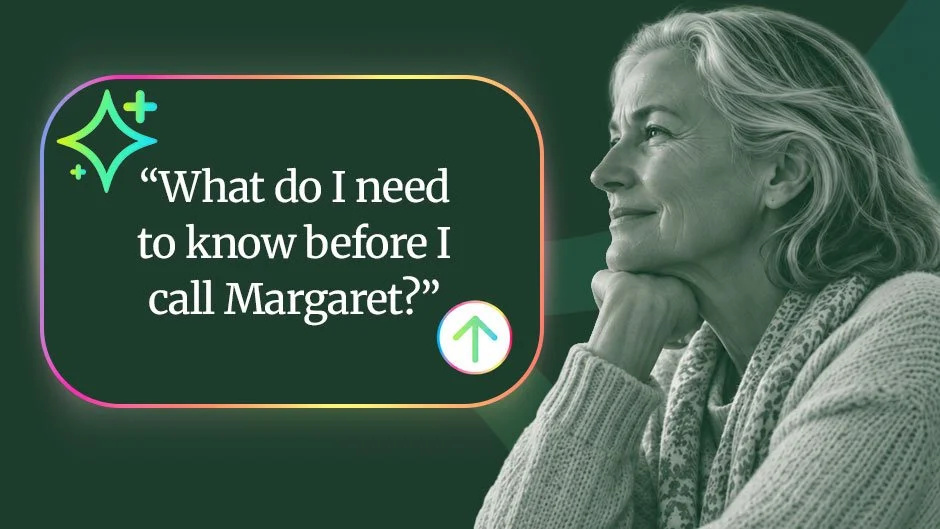
Margaret has been a client of her firm for twelve years. Penny is her relationship manager, working alongside an investment manager, a financial planner and the client services team. The firm knows about Margaret’s investments, objectives and attitude to risk. But Penny also knows that Margaret worries about running out of money, despite being financially secure. Her husband used to handle most of the finances but sadly passed away a few years ago. Her daughter lives in Australia. A couple of years ago, she discussed helping her grandchildren financially but wasn’t ready to proceed.
Some of that understanding is in meeting notes. Some is in messages. Some sits in the back-office system, and some is in the heads of people who have known Margaret for years. A summary of the latest meeting only captures part of it. Finding the right detail at the right moment can take time. Remembering every detail across a whole client bank is harder still. Our opportunity is to bring all of that accumulated understanding together to help your team use what your firm already knows to make each conversation more informed and more personal.
To see why context matters so much, imagine giving an AI tool just the transcript of Margaret’s latest review. It can tell Penny what was discussed. It may extract the data, summarise the conversation and suggest some follow-up actions. That saves work.
But if Margaret didn’t mention her grandchildren this time, that transcript cannot tell the AI about the conversation two years ago. If her anxiety surfaced in a message during a market fall, the transcript may say nothing about that either. However capable the model is, it cannot reliably draw on information it has never been given.
Now give that AI access to the relevant history of the relationship. It can draw on what Margaret has said before, how her circumstances have changed and why earlier decisions were made. The question becomes: what does this conversation mean in the context of what we already know about Margaret?
That requires more than collecting documents in one place. The client intelligence layer we are developing organises the information and how it relates, preserving who said what, when it happened and where it came from. Margaret considering a gift two years ago is different from her giving an instruction today. A comment about her daughter’s circumstances should not be confused with Margaret’s own wishes. Those distinctions give AI a stronger basis for a relevant, evidence-backed response.
How the components work together.
Moneyinfo connects the client engagement record with information from integrated back-office systems, platforms and portfolio management systems. Its client intelligence layer is being developed to organise that context for retrieval. Planda provides the AI capability used within the Moneyinfo experience, while Moneyinfo Manager provides the user interface and the processes through which people review outputs and progress work.
In the intended client intelligence flow, a user asks a question through Moneyinfo Manager. Planda’s AI retrieves relevant information from the context held in Moneyinfo, prepares a response and returns it to the user within Moneyinfo Manager. The purpose is to make the firm’s relationship history useful at the point of work, with sources and permissions central to the design.
We are also designing access to this context for other AI tools so we remain LLP[1] agnostic. Our development includes Model Context Protocol (MCP), as a route for this interoperability. The aim is to support your choice of tools and make the understanding captured through Moneyinfo useful across the firm’s wider technology environment.
Live webinar
Building an AI ready firm
Better AI starts with knowing your client.

Join Tess and Sim to explore how client history builds the foundations for better AI, with a look at what’s available in Moneyinfo today and the capabilities we’re developing.
Register now[1] This could be general‑purpose models like ChatGPT, Claude, Gemini and more specialist AI systems trained specifically for financial‑advice.